

Following the closure of the Epic and Apple litigation, mobile game developers are leading players in a more radical manner to the “high wall gardens” that apples hold, while seeking to circumvent in the process the 30 per cent high-stakes that apples have been “infamous” applications.

According to the recent landmark ruling of the mobile game consulting firm Liquid & Grit, based on the United States court in May – Apple was ordered to lift all applied in-sale (IAP) payment restrictions within App Store in the United States, to allow developers to provide out-of-store payment options, and to investigate specific options for 35 mobile game giants such as Supercell, Niantic and Playtika to sell IAP directly to players.
Liquid & Grit has grouped these emerging practical measures into four categories: a discount for a web store in the original IAP store, bullet window tips, game main interface buttons and guidance through the Game News and Mailbox system.
Pokémon Go and Clash Royale are embedded in a web store in a game store, but SuperPlay’s Dice Dreams is more radical: The player is pushed directly to the web store at the purchase node, while the “pay through apple” option is also ashted.
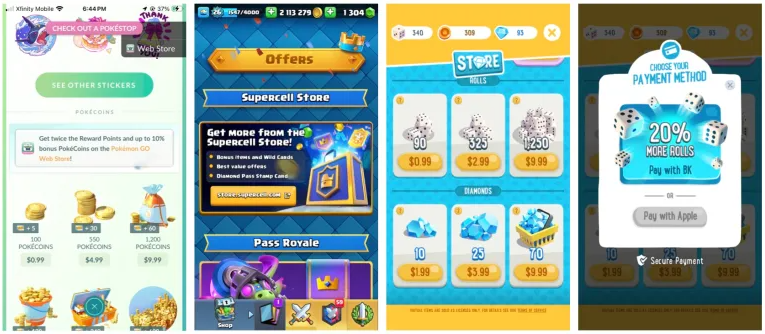
Naturally, among the products of the Liquid & Grit research, social casinos, such as Double Down Casino, Huuuge Casino, Gold Fish Casino, are the most active and use all four methods. In the traditional game class, Social Point ‘ s Dragon City was found to be leading players out of the apple payment system in all four ways.

According to a study by Liquid & Grit, the most common mode of guidance is “Providing a discount pack for a web-based shop in a native IAP store”, and many games such as Pokémon Go, June’s Journey, Solitaire Grand Harvet, use this technique.
Supercell’s orientation strategies vary from one product to another: Brawl Stars and Clash of Clans are currently being directed only through the IAP store, while Clash Royale has multiple bullet windows to guide players to the web. Zynga ‘ s Empires & Puzzles avoids advertising in the IAP store and uses three other modes of guidance (blast windows, main interface buttons and inbox links).
The website store ” Jedi for Life ” , presented in the form of a bullet window inside the IAP store, supported Apple Pay ‘ s payment, and clicking on the return key triggers a page to indicate the benefits that the player may miss.

Miniclip ‘ s 8 Ball Pool is guided by a dual IAP shop and game news function, while EA uses a differentiated strategy: Playdemic ‘ s Golf Clash is guided by the main interface and news transmission, while Madden NFL has web-based store links in store, window and mailbox functions.
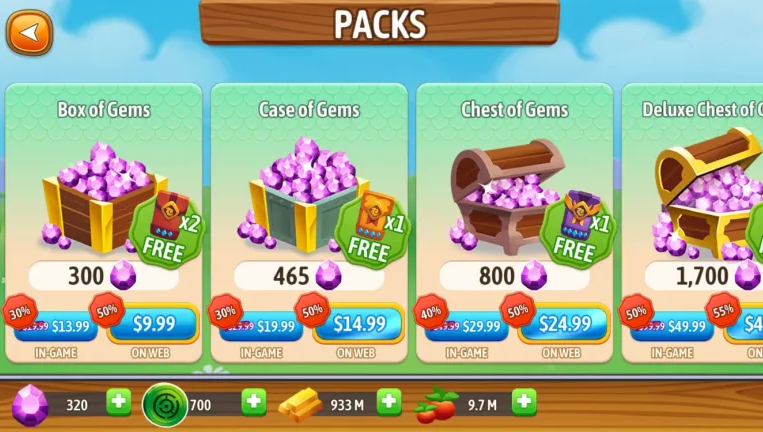
Liquid & Grit analysis shows that all the Playtika games studied (including Board Kings, Caesars Slots, Slotomania, Solitaire Grand Harvest, June’s Journey) offer web-based shop options at the purchase point, highlighting their D2C (directly to consumers) channel preferences by comparing the more expensive App Store native IAP with the more affordable one. Four of these games provide 20-25 per cent of the extra currency, while June’s Journey provides a higher premium currency exchange rate.
There is not yet a uniform standard of best practice, but the Liquid & Grit study suggests that the purchase of bullet windows seems to provide the most natural flow of users. In another report on the shift from mainstream to D2C, Liquid & Grit mentioned that Spotify, Twitch, TikTok and Disney+ had led users out of the store in a slightly different way.
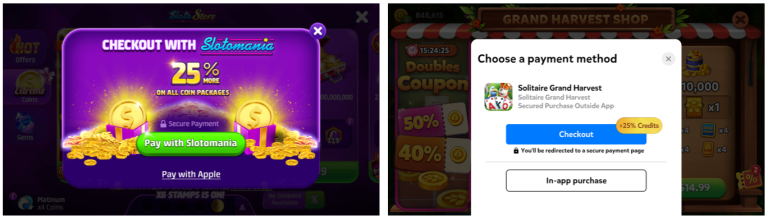
Playtika is one of the most active manufacturers in deploying pop-up windows to attract network consumption.
The report concludes: “Enterprises with their own website resources should consider operating web shops on their own and using paid processors such as Stripe, Adyen or Paysafe to process card transactions. Developers who do not wish to build their own stores can also quickly get online in cooperation with full-service web-storage providers such as Xsolla, Stash, Appcharge or Fungies. Although these custodians charge higher fees than independent processors, they still fall far short of the 30 per cent withdrawal of apples.”